Sunday, December 28, 2025
In modern football, experts, coaches, and fans use numerous metrics to dissect a match. One of the most prominent is Expected Goals (xG). So, what exactly is Expected Goals? How is it calculated, and what role does it play? Let’s dive into this in-depth analysis to gain a more accurate perspective when analyzing football data.
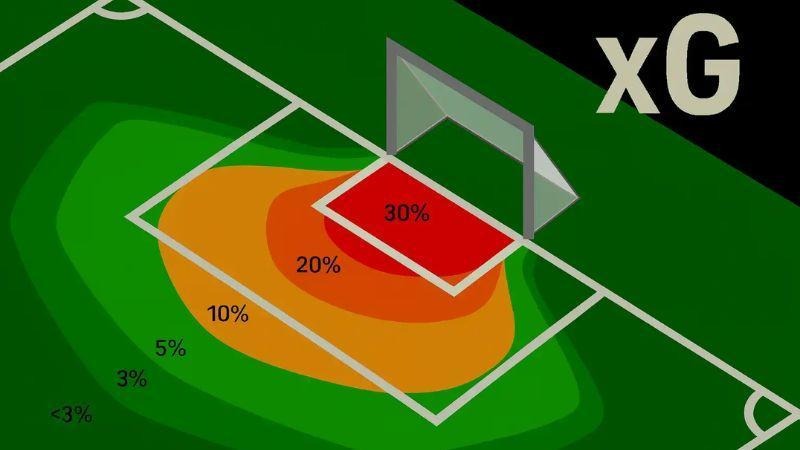
Expected Goals, commonly abbreviated as xG, is a key metric in modern football data analytics. This index measures the likelihood of a shot resulting in a goal based on various contextual factors.

Expected Goals (xG) is a metric that measures the likelihood of a shot resulting in a goal.
In other words, Expected Goals (xG) does not reflect the actual number of goals scored in a match. Instead, it tells you the probability of each individual shot resulting in a goal. For example, a finishing move from inside the six-yard box with an xG of 0.7 means there is a 70% chance of scoring.
Notably, the xG metric is calculated for both individual players and the entire team. This figure serves as a clear indicator of the form, strength, and clinical efficiency of a team or player in front of the goal. This is precisely why xG has become an indispensable analytical tool for football clubs and teams worldwide. At sports betting platforms like Sunwin, xG is also a key metric that many bettors research thoroughly before placing their wagers.
Unlike corner kick statistics or goal counts, which are simple to track, xG is calculated using sophisticated software and complex statistical models. These models analyze historical data from thousands of past goals to determine probabilities. The formula for xG is not fixed; rather, it depends on the specific context of the scoring opportunity. Specifically, when calculating the Expected Goals (xG) value, the following factors are considered:

How to calculate the xG index
All these factors are evaluated objectively using statistical probability models. From this, the Expected Goals (xG) metric is generated to provide an accurate analysis of the attacking efficiency of both players and teams.
In football, the final score does not always accurately reflect the events on the pitch. This is where Expected Goals (xG) proves its value. Below is a summary of the critical roles xG plays in modern football data analysis:
If match data shows a team has a high xG but few actual goals, it indicates they played well and created high-quality chances. A high xG signifies that the team generated numerous dangerous finishing opportunities. The low actual goal count may simply be due to a lack of clinical finishing or a bit of bad luck.
In modern football, Expected Goals (xG) is considered the key to effective tactical analysis. This metric allows for an assessment of a team’s level of match control. Through xG, experts and coaches can determine whether a team is consistently creating high-quality scoring opportunities. Based on these insights, managers can make calculated tactical adjustments when necessary.
For instance, if a team has a low xG despite having many shots from a distance, it indicates a need to refine their formation. The coaching staff and players must solve the problem of positioning and how to better penetrate the opponent’s penalty area. Conversely, if the opponent maintains a high xG, the technical staff can use this data to identify defensive gaps and implement improvements to turn the tide of the match.
In any given match, whether a player scores can sometimes be attributed to luck. However, xG largely eliminates the “luck factor,” revealing a player’s true goal-scoring proficiency and efficiency. Coaches rely on this metric to compare and evaluate strikers accurately.
Suppose a striker records a high xG in a match but scores very few actual goals; this suggests a lack of clinical finishing. Such a player needs to work on their conversion skills. On the other hand, a player with a low xG who manages to score multiple goals demonstrates exceptional “predatory” instincts. This player belongs to an elite group of finishers who can maximize even the half-chances.
xG helps evaluate player performance.
Additionally, Expected Goals (xG) helps in objectively predicting a team’s long-term performance. This metric prevents you from misjudging a team’s true caliber when their actual goal count remains low. Accordingly, if a team maintains a consistently high xG throughout a season, it is a strong indicator of stable form and high technical proficiency.
While xG is a powerful tool for football data analysis, it is important to note that it is not flawless and possesses certain limitations:
Therefore, to evaluate a football match comprehensively and objectively, you should combine xG with other key metrics such as Pressing intensity (PPDA), Possession percentage, and Shot volume.
The above provides a detailed analysis of Expected Goals (xG) brought to you by Sunwin. We hope you now have a clear understanding of xG to enhance your football viewing experience. By adding this modern, scientific, and intuitive analytical tool to your arsenal, you can approach football data with much greater depth and confidence..

In modern sports betting, winning or losing a single bet is no longer the sole measure of a player’s ability. Instead, experts use a metric called Closing Line Value (CLV) to measure and evaluate the quality of a wager. Let’s dive into the details to understand how this metric works. 1. What is Closing Line Value (CLV)? In simple terms, Closing Line Value (CLV) is a metric used to assess...

In the world of sports betting, Implied Probability and Margin are two terms you must master. These concepts are the keys to making smart investment decisions and avoiding unnecessary risks. Let’s dive into the details below. 1. What is Implied Probability? Simply put, Implied Probability is the “hidden likelihood” within a bet. It is the process of converting betting odds into a percentage that represents the bookmaker’s assessment of an...

Sharp Money and Public Money are two concepts frequently encountered in sports betting. However, not every player fully understands the essence of these terms or why they are so vital to the betting experience. In this article, Sunwin will answer all your questions in detail, helping you grasp these concepts to achieve the best possible betting results. 1. Properly Understanding Sharp Money vs. Public Money Simply put, Sharp Money and...